
Introduction:
The “Bible” and “Science” have been at odds about the age of the world since the middle 20th Century. In fact, these two are now millions and sometimes billions of years apart in their answers to that question depending on which Biblist or scientist you ask. The great divide between the two occurred in the late 1940s with the development of a new scientific method for dating artifacts. Books written before the 1940s generally agreed with the biblical account. Books written after 1950 began to disagree with the biblical account.
Thank you for reading this post, don't forget to subscribe!To begin our discovery to answer this question, we will deal with the Bible account first. According to the time markers in the book of Genesis, it covers the first 2350 years of history from the creation to the death of Joseph in Egypt. Moses recorded the book of Genesis 2688 years after the creation, or 338 years after the death of Joseph. As another anchor, Moses recorded the book exactly 430 years after Jacob moved his family to Egypt at the bidding of his son, Joseph. On our current Gregorian calendar, we would set the year of Moses’ record as 1465 BC. Exodus and Leviticus were written in the same year. Genesis was dictated to Moses on Mount Sinai during one of his 40-day stays on the mount in the first year out of Egypt. Leviticus was dictated to Moses in the Tent of Meeting toward the end of the first year out of Egypt. Exodus is a record of Moses’ interaction with Pharaoh and the LORD’s magnificent acts along with the Commandments and Tabernacle construction information dictated to Moses by the LORD on Mount Sinai. These are the oldest known manuscripts in the world. Numbers and Deuteronomy were completed by Moses at the end of the fortieth year out of Egypt. These five books were in print at least 865 years before the next oldest books in print, Homer’s Odyssey and the Iliad which were written in the late 700s BC or early 600s BC. Although we have thousands of full and partial copies of the first five books of the Bible that match word for word, only about one-third of the Odyssey and Iliad exist in the oldest copies and the rest of their content has been created by editors. We have many copies of the first five books of the Old Testament that are more than 2000 years older than the oldest copies of Homer’s works in existence.
The Age of the World According to the Bible:
How Time is Measured
In the entire Old Testament, from Genesis to Malachi, time is measured in 1) hours, 2) days, 3) months, 4) years, and 5) seasons. At first glance, you might say, “That all looks right.” However, the days, months, and years of the Old Testament are different from the days, months, and years that the Western World, including America, use today. Notice I used the words “Western World.” It is a very important distinction. Many countries of the “Eastern World” still use the Old Testament time measurements today. They never changed from the original system that was used by all the nations of the world until after the book of Malachi was finished. In the years between the Books of Malachi and Matthew, Western World countries began altering the months of each year in an attempt to align them with the seasons of winter, spring, summer, and fall. It took hundreds of years to get the math right. Finally, Julius Caesar and the Roman Empire made the switch from the Old Testament measurement of time to the calendar we generally use today in the Western World. At this point, we need to define how time was measured in the Old Testament.
How Time was Measured in the Old Testament
An Hour
An “HOUR” in the Old Testament is the same as our hour today.
A Day
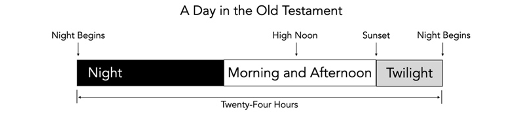
A “DAY” in the Old Testament always has 24 hours just as ours does today; however, the day started at dark after twilight was over. Twilight is the time between the setting of the sun and the reflection of the sun’s rays below the horizon are completely gone. The day does not end until the end of twilight on the following day. Here is an example.
A Month
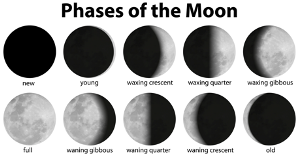
A “MONTH” in the Old Testament is different from our “Western World” months. All the world, until after the Book of Malachi was finished counted months from the “New Moon to the New Moon of the Next Month.” This is called a “Lunar Month.” Each “Lunar Month” averages 29 ½ days. Because of the location of the “New Moon” in the sky, one month will have 30 days and the following month will always have 29 days. The cycle is always 30 days, 29 days, 30 days, 29 days, etc.
A Year
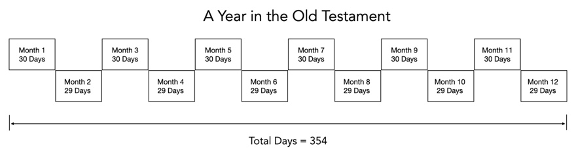
A “YEAR” in the Old Testament is different from our “Western World” years. An Old Testament year contained exactly 12 lunar months. This is called the “Lunar Year” and is still used by many “Eastern World” countries. Here is an example of the “Lunar Year.”
In our Western World, our year is called a “Solar Year,” and it contains 365 days, 5 hours, 48 minutes, and 46 seconds – not exactly as precise as the “Lunar Year.” The “Lunar Year” is 11 days shorter than the “Solar Year.” The “Solar Year” was developed in the four hundred years between the Books of Malachi and Matthew. Many countries began this change in order to align the 12 months of the year with the 4 seasons of the year. It was an attempt to have the same months of the year falling in the same seasons of the year, every year. With the “Lunar Year,” every year, the months fell back by 11 days. What does that matter? It mattered because every month of the “Lunar Year” fell in every season of the year, sometime in its 29-year cycle. As an example, “Month 1,” which we call “January,” would fall in the middle of winter one year, and 14 years later, “January” would fall in the middle of summer. All the other months followed the same path. The change to the “Solar Year” fixed the problem so “January” always fell in the middle of winter every year. As a result, for the Jews, Passover would always fall in the same season that it occurred in Egypt with Moses. However, throughout the Old Testament, because Passover was tied to Nissan 15, the first month on the Jewish Calendar, it was celebrated in every season of the year in the 29-year cycle.
A Season
A “SEASON” in the Old Testament was the same as our seasons – winter, spring, summer, and fall. These seasons were not tied to any months of the “Lunar Year.” Each season lasts about 91 ½ days. The crops were planted according to the signs of the seasons, not in a certain month of the year. Here is an interesting comparison between the Old Testament use of the word “season” and the word “time.”
In Genesis 17:21, the LORD told Abram that Sarah would give birth to a son “at this season next year.” Since a season is about 91 ½ days, Sarah would need to become pregnant at the end of the current season so that after 9 months (266 days) of gestation, the baby can be born in the same season as the announcement. Then, in Genesis 18:10, a little more than 3 months after the first announcement, the LORD said to Abram that Sarah would give birth to a son, “at this time next year.” Now, Abram knows the month of and the season the son will be born.
With all of that as an introduction, we will focus only on the “Lunar Years” of the Old Testament to count down to the Birth of Jesus.
How Many Years Between Creation and the Birth of Jesus
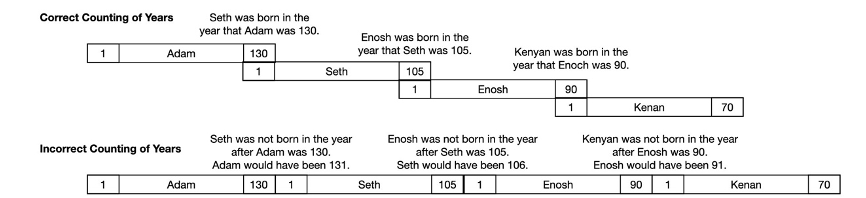
Adam was created on the sixth day of creation according to Genesis 1:26-31. In Genesis chapter 5, we are given a list of the descendants of Adam all the way to Noah and the birth of his three sons. In Genesis 7, we find where Noah was 502 when Shem was born. In Genesis 11, we are given the descendants from Shem to Abraham. In Genesis 21 we are told of the birth of Isaac. In Genesis 25 we are told of the birth of Jacob. In each case, we are told how old each father was when his son was born. Here is the list in spreadsheet form. We start with Adam, who was created in year 1, and count the years forward with the birth of each son. We must count them correctly.
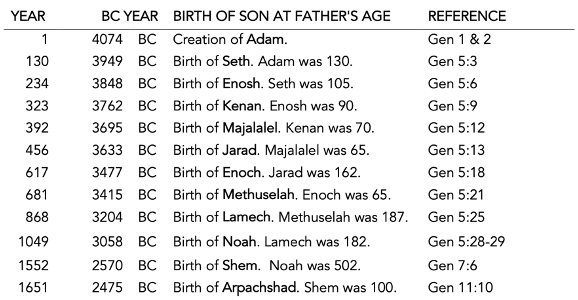
Adam was 130 when Seth was born. Seth was 1 year old in the same year Adam was born. Seth was not born after Adam was 130 years old. If he was, he would have been born in Adam’s 131st year, not his 130th year.
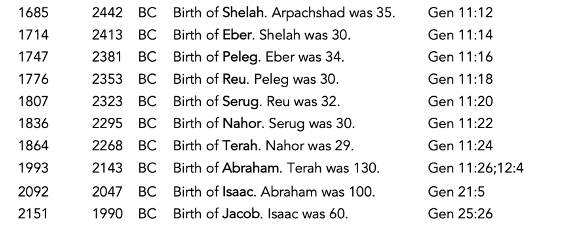
At this point, we need to change from counting the ages of each father at the birth of each son to entering the date that Jacob moved his family to Egypt in 2279.
NOTE: No counting system in the world used a “0” [Zero] until after the Old Testament was completed. Still today, in almost all Oriental and Eastern countries, at birth, a child is 1 year old. They do not count months. and then call a child 2 years old on the anniversary of completing a year. As you can see from the list, Jacob was born 2151 years after the creation of Adam.
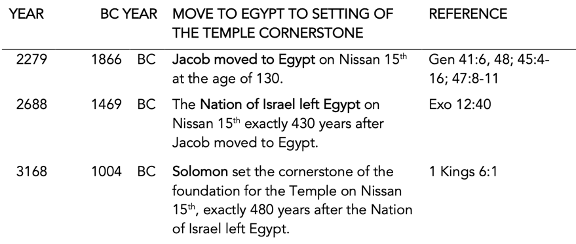
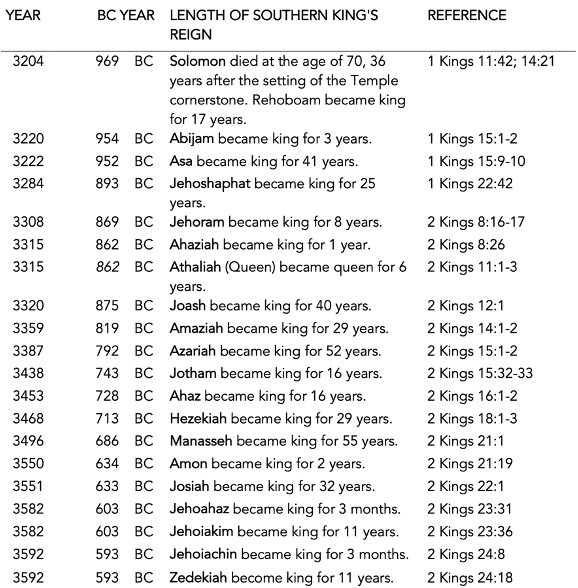
By counting wrong, you will accidentally add one year person to the total list of years. For the descendants of Adam, this will be through the count over by 23 years. This same counting method must be used when we arrive at the list of Israel’s Southern Kings. The reign of each new king coincides with the year of the death of the previous king.
Now we are fortunate that we can move quickly to the date of the Exodus in 2688. Now we are fortunate that we can move quickly to the setting of the cornerstone for the building of the Temple in Jerusalem by Solomon in his 4th year as king in 3168.
We must now move through the Southern Kings of Israel to come to the date of the fall of the Southern Kingdom to Nebuchadnezzar and then to Cyrus the Great.
The Monarchy of Persia began with Cyrus the Great in 550 BC and ended with the Shah of Iran in AD 1979 during the Iranian revolution during the U.S. presidency of Jimmy Carter. Accurate records of this lineage were kept of this string of monarchs by Persia/Iran. It was the longest-running monarchy in the history of the world – Cyrus the Great to Mohammad Reza Pahlavi, 2536 solar years in total.
The Monarchy of Persia began with Cyrus the Great in 550 BC and ended with the Shah of Iran in AD 1979 during the Iranian revolution during the U.S. presidency of Jimmy Carter. Accurate records of this lineage were kept of this string of monarchs by Persia/Iran. It was the longest-running monarchy in the history of the world – Cyrus the Great to Mohammad Reza Pahlavi, 2536 solar years in total.
Mohammad Reza Pahlavi was the last Shah (King) of the Imperial State of Persia/Iran until the Islamic Revolution on February 11, 1979.

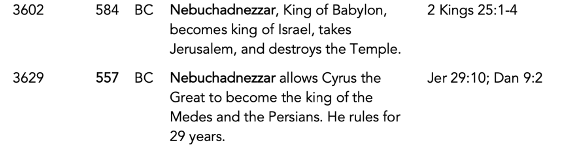
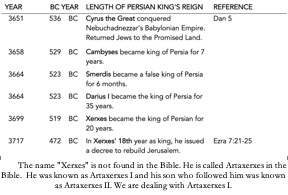
Cyrus the Great came into power in the 3629th year after the creation of Adam or 557 BC. However, he did not conquer the Babylonian Empire until the night that Daniel read the handwriting on the wall in the 3651st year after the creation of Adam. Our list shows the next four Persian kings that followed Cyrus to arrive at Xerxes (Artaxerxes I) in order to see how he fulfilled a prophecy of Daniel.
According to Daniel 9:25, “So you are to know and discern that from the issuing of a decree to restore and rebuild Jerusalem until Messiah the Prince there will be seven weeks [of years] and sixty-two weeks [of years]….”
Ezra 7:21-25 tells us when the decree that matches Daniel’s prophecy was given.
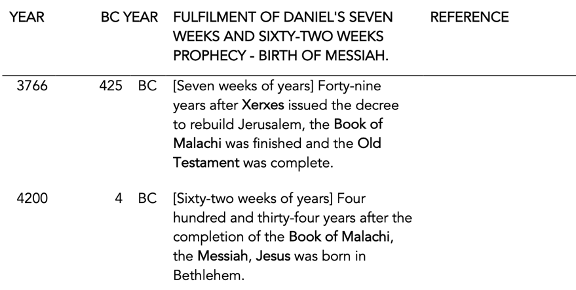
Even though our English Bibles say “seven weeks and sixty-two weeks,” the Hebrew is clear that these are weeks of years. What does that mean? It means “seven weeks” times seven years. Thus, the seven weeks equals 49 years until something happens, and the sixty-two weeks equals 434 years until the birth of the Messiah, Jesus. When did the decree happen? According to Ezra 7:21-25, it happened 3717 years after the creation of Adam.
The “seven weeks and sixty-two weeks,” are two separate events. What happened at the end of the first 49 years? Here is the answer.
What happened at the end of the first 434 years? Here is the answer. The birth of Jesus.
The Conversion of 4200 Lunar Years of the Old Testament
to the Solar Calendar that we use today.
In the 708th year, after the establishment of Rome by the Romulus Brothers, Julius Caesar proposed a yearly calendar of 365.25 days to fix the months to fall during the same seasons each year. It was called the Julian Calendar. The new calendar became effective on January 1, in the 709th Roman year. In the Roman year 1279, Dionysius Exiguous changed the way the years were recorded and backdated the Roman year 708 to become 46 BC. Therefore, the new calendar was backdated to reflect that it began on January 1, 45 BC. Forty-one years later, Jesus was born in 4 BC, or in the 4202nd year since the creation of Adam on the sixth day of the first year. (Note: Pope Gregory will correct the days to 365.2425 each year. We will address that change later.)
Converting the 4200 Lunar Years to Solar Years is easy. All we have to do is multiply the 4202 Lunar Years times 354 days in a Lunar Year and then divide by 365.2425 days in a Solar Year. Here it is.
4200 Lunar Years X 354 = 1,486,800 days / 365.2425 days = 4070 Solar Years.
What does that tell us? It tells us that if we want to retrofit our Solar Calendar back to the first year of creation, it occurred in 4070 years before Jesus’ birth. To that, we must add 4 years to come to year 1 on the Julian Solar Calendar. Therefore,
The World was Created in the year, 4074 BC.
The Julian Calendar seemed to work well until it was discovered that the calendar maker had placed the leap year every 3rd year instead of every 4th year. This caused the Spring Equinox to shift by 3 days on the calendar. Caesar Augustus fixed the problem by ignoring the leap years from 5 BC to AD 8 resulting in the 3 days being added back into the calendar.
Then by 1582, the Spring Equinox was once again off by 10 days. Pope Gregory fixed the problem overnight. On Thursday, October 4, 1582, all the Catholic Country went to bed and woke up on Friday, October 15, 1582. Ten days on the calendar disappeared. The newly adjusted calendar’s name was changed to the Gregorian Calendar which most of the Western World use today. At the same time, the length of the solar year was changed from 365.25 to 365.2425, and century years were never to be leap years. Note: The United States did not make the Gregorian change until September 2, 1752. America went to bed on Wednesday, September 2, 1752, and woke up on Thursday, September 14, 1752, removing 11 days from the Julian Calendar.
As we answer this question, we are living in the year AD 2023. Jesus was born in 4 BC. Therefore, Jesus was born 2023 + 4 = 2027 years ago.
How Old is the World According to the Bible?
To find out how old the world is according to the Bible is easy. All we have to do is to add 4074 BC plus AD 2023 to find the answer.
4074 BC + AD 2023 = 6097 Years since the first year of creation.
The world is 6097 years old according to the Bible.
But the Bible uses “Lunar Years” instead of “Solar Years.” All the prophecies were given according to the strict “Lunar Calendar.” The big question that is always lurking in the minds of Christians is, “How long will it be until the Second Coming of the LORD?” He will return on the 7000th Lunar Year to bring rest to the world during His reign as King of kings and LORD of lords but is in Lunar Years. So, we will need to convert 6097 Solar Years back to Lunar Years. Here it is.
6097 Solar Years X 365.2425 days per year = 2,226,883 days / 354 days = 6,290 Lunar Years
We are 6,290 Lunar Years since Adam’s Creation, the Calendar God Created and Uses.
The Age of the World According to Science:
Unlike the hard facts found in the Bible with specific years for each step to arrive at the age of the world, according to the Encyclopedia Britannica, science uses
“radioactive dating techniques to determine the approximate ages of Earth’s oldest known rocks and minerals. They estimate that Earth formed more than 4.4 billion years ago. Although no one knows when the outer crust of the planet began to form, some scientists believe that the existence of a few grains of zircon dated to about 4.4 billion years ago confirms the presence of stable continents, liquid water, and surface temperatures that were probably less than 100 °C (212 °F).” [1]
Radioactive Dating:
Just what is “radioactive dating,” when was it developed, and how far back does it accurately date objects?
For simplicity, we will use the information provided by a very old website called, “How Stuff Works.” It is a simple website for youth to find just enough information without too many details. This site was introduced to me by Albert Pittman in 2002 when this question came up one day.
Carbon 14 Dating:
According to “How Stuff Works,” the first radioactive dating process was called “Carbon 14 Dating.” It was used to determine the age of an object containing organic material which includes compost, certain types of mulch, lawn clippings, manure, and beneficial fungi. Only living organisms can take in Carbon 14.
In 1946, Willard Libby published a paper in which he proposed that the amount of carbon in living matter might include Carbon 14 as well as Carbon 12. Carbon 14decays over time, Carbon 12 does not. The process was to measure the amount of Carbon 14 as compared to Carbon 12to determine an age. The process became fully accepted in 1949. However, the process can only give an estimate. Every dating report begins with the word “about.” It means, no one knows.
Since 1949, other isotopes besides Carbon 14 have been used, but all with similar results. The report is always “about” a certain age and only an estimate.
In 2001, when I first looked at Carbon 14 in “How Stuff Works,” I was intrigued by a line at the end of the article that is still there today. It says the following.
However, radioisotope dating may not work so well in the future. Anything that dies after the 1940s, when nuclear bombs, nuclear reactors and open-air nuclear tests started changing things, will be harder to date precisely.[2]
This is interesting. The first nuclear bomb exploded on July 16, 1945, before Carbon 14 dating was developed and embraced. The article has been changed since 2001 to that stated above. In 2001, the article indicated that things tested by Carbon 14 dating prior to the nuclear bomb explosion dated much younger, to the accepted age at the time, and then dated much older when tested after the explosion of the nuclear bomb. Here is the problem. As we have discovered, Carbon 14 did not exist prior to the explosion of the first nuclear bomb. Could they have tested objects that had not been affected by the explosion in those first few years? Yes. I suspect that Willard Liddy and his team tested items in the development process and recorded acceptable dating of the time. Then, years later, the same items were tested, and a much older dating was recorded. For example, in 1946 the teeth enamel formed in 1930 of seven-year-olds who had died, tested at sixteen years old – right on the money. Then, in 1980, the teeth enamel of seven-year-olds who died in 1955 was tested. They were found to be 340 years old, even though the child had died only 25 years before. The reason was the extreme rise in radioactive material in the atmosphere from the explosions of nuclear bombs, etc.
According to the Carbon 14 Dating process, the half-life of Carbon 14 is 5,700 years, which clearly falls within the timeline of the Bible record.[3] Once the attempt to date beyond 5,700 years, no website agrees on how far beyond that number of years is accurate. Simply stated, it is all speculation and fabrication. All the organic material can be Carbon 14 dated provided the material has not completely decomposed. For example, bones found intact in layers of soil can be tested. When the bones have decomposed, they cannot be tested. However, things such as rock, dirt, clay, or water cannot be radio-isotope tested in any method known today. Why? Because they were created by the LORD to appear to be much older than they actually were when they were created.
Potassium-Argon Dating:
On May 18, 1980, Mount St. Helens erupted. The whole summit was blown off, and everything within eight miles was obliterated. Ash fell across 22,000 square miles. But traces of the ash were carried around the world. Steven Austin, a Ph.D. research geologist, took a 10-year-old sample from the lava created in the Mount St. Helens eruption and sent it to be K-Ar dated [Potassium Argon Dating] at the Geochron Laboratories of Cambridge, Massachusetts. The process dated at lava at “about” 340,000 years old even though the sample was only ten years old. Non-geologist began to criticize Austin stating that the lava was actually millions of years old. Finally, the excuse was that the half-life of potassium 40 is 1250 million years. One source used a calculation to say that because the sample was less than 10,000 years old it could not be accurately tested. Another source said that the sample must be more than 6,000 years old to be tested accurately. Another source says that the potassium 40 was diluted by surrounding elements and that caused the sample to test much older because of the remaining ratio of potassium to argon in the sample.
Conclusion:
Colossians 1:16 says, “For by Him all things were created, both in the heavens and on earth, visible and invisible, whether thrones or dominions or rulers or authorities—all things have been created through Him and for Him.” Everything was created in six days, and that includes all the rocks, minerals, water, and gases. According to the Bible, all those elements are 6097 solar years or 6290 lunar years old. However, in order for those elements to interact and work in perfect harmony, the LORD created them totally mature in every way, they had to be created as if they were millions of years old, even though they were all created in six days and were all less than six days old at the time. (Simple example: The trees were created with fruit on them that day – Gen 1:11.) Therefore, any man-made discovery of some dating method might date the age of the elements as they appear to be because of how the LORD created them, but not their actual age.
[1] https://www.britannica.com/story/how-old-is-earth
[2]https://science.howstuffworks.com/environmental/earth/geology/carbon-14.htm?srch_tag=72vrqncmlhg7buel6lfqoekza4earazc
[3] Ibid.